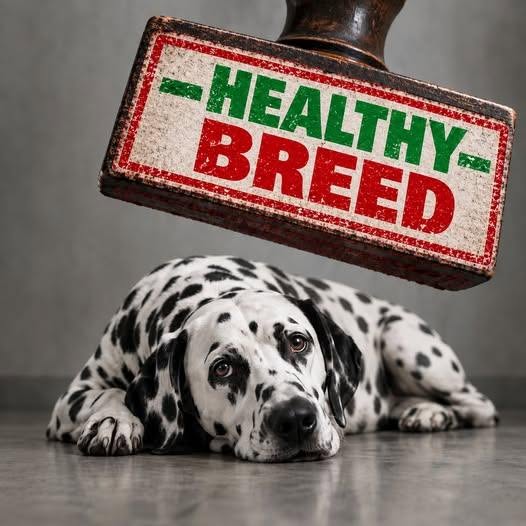
Healthy Breed
We are following current developments regarding the “Hund und Pferd” dog show in Dortmund, scheduled for November 2026, with great concern. The responsible veterinary authority has ordered measures to exclude dogs exhibiting traits associated with “torture breeding” from the show. Almost all breeds are affected; for Dalmatians, requirements are being imposed that, in our view, are neither scientifically justified nor proportionate.
Essentially, two traits associated with torture breeding are being attributed to Dalmatians. The first concerns deafness. Without a scientific basis or established threshold values, a hearing test is being required for a subset of dogs, depending on the amount of white pigmentation on their ears. Dalmatians with predominantly pigmented ears would not need to provide a hearing test, whereas those with predominantly white ears would be required to do so. It goes without saying that this approach is scientifically unfounded and entirely subjective. Moreover, since VDH show regulations already prohibit the showing of deaf dogs or those with hearing in only one ear, this requirement is completely unnecessary. Furthermore, the fact is overlooked that, thanks to years of voluntary measures by Dalmatian breeders, the deafness rate in the breed no longer differs significantly from that of many other breeds. Despite its absurdity, however, this requirement can generally be met without difficulty, as almost all Dalmatians bred in Europe possess a BAER test certificate.
Far more serious is the requirement regarding hyperuricosuria. The veterinary authority demands either a genetic test proving the dog is a LUA Dalmatian, or veterinary blood and urine tests showing no „abnormalities“. In our opinion, this requirement results in large segments of the breed being excluded from the exhibition without cause, or at least forced to undergo disproportionate testing. It can be demonstrated that these requirements are scientifically and medically flawed. Here, a genetic predisposition is being conflated with the manifestation of clinically significant symptoms. German law permits the exclusion of only those animals exhibiting demonstrable symptoms (suffering, pain, impaired social behavior), not a blanket, breed-wide exclusion of asymptomatic animals.
The invasive collection of urine samples via catheter would cause severe distress to the affected dog (risks of inflammation and injury, stress, pain, etc.) and is therefore disproportionate to the suspected health risk.
The authority treats the mere fact of elevated uric acid levels as a characteristic of “torture breeding”, yet fails to provide scientific evidence to support this claim. It is difficult to determine with certainty how frequently Dalmatians actually develop urate stones, as there appear to be significant differences between individual populations and even breeding lines. Many years ago, WAFDAL conducted a study on the prevalence of urate stones; the results showed a rate of 2%, based on data from the Netherlands and Norway. Since the risk of urate stone formation also depends on environmental factors, one must assume a combination of environmental influences (diet, fluid intake, activity levels, etc.) and complex genetic factors extending beyond the aforementioned SLC2A9 gene. The authority has failed to take this complex situation into account.
Furthermore, form our point of view, this is a violation of the principle of equality: generally, regardless of breed, up to 3% of domestic dogs develop bladder stones at some point in their lives. Thus, Dalmatians do not appear to be affected by stones more frequently than other dogs. In a survey conducted by a well-known German laboratory, Dalmatians did not even make the “top 20” list of dog and cat breeds affected by bladder stones. Other types of stones (e.g., struvite, oxalate) occur far more frequently in domestic dogs than urate stones, yet they were ignored by the responsible veterinary authority. The action taken against Dalmatians therefore appears arbitrary, as no such requirements regarding bladder stones were imposed on other breeds. In any case, one cannot conclude from a mere genotype (HUA/LUA) or undefined blood and urine tests whether a specific dog is actually suffering from urate stones or any other type of stone.
In our view, the aforementioned requirements cannot be scientifically justified; we believe the imposed measures are more detrimental from an animal welfare perspective than the low risk posed by urate stones. Moreover, from a legal standpoint, notices from authorities based on flawed scientific sources are invalid.
We condemn the actions of the responsible authorities and reject the classification of the Dalmatian as a “torture breed” as unfounded and incorrect. Our German member clubs—together with other associations—are rightly opposing this unscientific and apparently ideologically driven approach. It is unacceptable for a small, vocal minority of animal rights fundamentalists to impose their personal ideology, exert political influence against the will of the democratic majority, and apparently influence authorities in the process.
WAFDAL expressly supports the concept of animal welfare and promotes the breeding of the healthiest possible dogs. The Dalmatian serves as a prime example here, as our breeders have voluntarily implemented various measures—such as hearing tests and specific breeding programs—to improve health for decades. With a life expectancy of approximately 13 years, the Dalmatian outlives comparable breeds as well as mixed-breed dogs.
We firmly reject excessive measures that affect only registered breeders. Preserving the health of our breed can only be achieved through dialogue with breeders, not through legislation or administrative orders. Animal welfare is not served when registered breeders face discrimination, causing breeding activities to shift to backyard operations or other countries.
As early as four years ago, we publicly warned of the danger that purebred dog breeding was facing increasingly aggressive action under the guise of animal welfare. Unfortunately, our fears from that time have been confirmed over the years. Active measures are being taken against purebred breeding based largely on scientifically incorrect claims, often while disregarding or misinterpreting the legal framework.
We also indicated back then that regulations regarding dog shows were merely a first step, intended to be followed by restrictions on breeding and, eventually, on the ownership of purebred dogs. Our fears have proven well-founded in this regard as well, following the adoption of the EU animal welfare law in mid-August 2026. Article 8 of this law stipulates that breeders must no longer use dogs with certain detrimental genotypes for breeding purposes. In other words, the mere presence of a genotype—even one that does not manifest phenotypically—is to result in a breeding ban. If the view takes hold that HUA Dalmatians carry a health-endangering genotype due to their unique SLC2A9 variant, then—once this law comes into effect—conventional Dalmatian breeding will no longer be possible.
This is therefore no longer merely a “German problem,” and the show in Dortmund is just the tip of the iceberg. We must all understand that this represents an EU-wide threat to the survival of our breed and to purebred dog breeding as a whole. It is now up to all of us—whether WAFDAL members or not—to coordinate our efforts internationally and use the coming years to secure a future for Dalmatian breeding and the show circuit.


Leave a Reply
Want to join the discussion?Feel free to contribute!